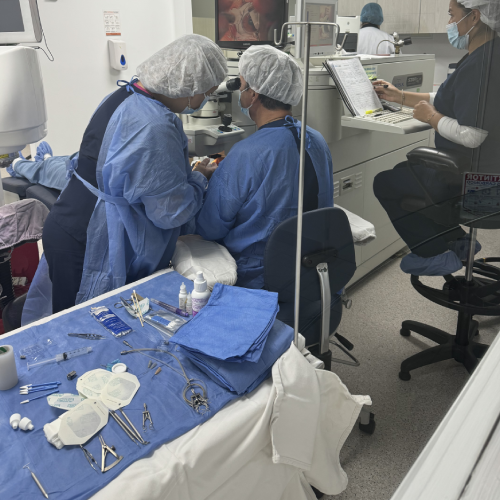
Corneal transplant consists of replacing the host’s diseased corneal tissue with a healthy cornea from a donor. The corneal graft can be partial thickness or full thickness.
General indications
General indications
Optical keratoplasty is performed to improve vision, the most important indications are keratoconus, scars, corneal dystrophies
Grafting may be performed to restore or maintain corneal integrity in eyes with large structural lesions such as thinning descemetocele.
Therapeutic corneal transplantation facilitates the removal of infected corneal tissue in eyes that do not respond to antimicrobial treatment.
Cosmetic transplants can improve the appearance of a diseased eye.
In general the most favorable cases are:
Keratoconus
Localized Scarring
Dystrophies
PostoperativeTreatment
Topical corticosteroids: they are used to reduce the risk of immunological rejection of the graft; it is common to maintain corticosteroids at low long-term doses, such as once a day for a year.
Topical cyclosporin: usually reserved for high-risk patients
Cycloplegia:
for 1-2 weeks.
oral acyclovir: in the context of previous herpes simplex keratitis to reduce the risk of recurrence.
Control of intraocular pressure:
Applanation tonometry is unreliable, which is why we resort to other tonometry methods.
Suture removal:
It is carried out when the host graft union has healed, usually 12-18 months. Broken or loose stitches should be removed as soon as they are identified, as this reduces the risk of transplant rejection.
PresionIntraocular
La presión intraocular (PIO) depende del equilibrio entra la tasa de producción de humor acuoso y la tasa de drenaje del humor acuoso
Está relacionado con la resistencia encontrada en la malla trabecular y el nivel de presión venosa epiescleral.
PresionIntraocularNormal
El límite superior en adultos es de 21mmHg mediante la tonometría.
Algunas personas sufrirán daño glaucomatoso inferior a 21 mmHg.
La reducción de la PIO es un elemento modificable fundamental en todos tipos de glaucoma
Algunos factores afectan a la susceptibilidad del nervio óptico a la lesión, como la integridad de su vascularización y la vulnerabilidad estructural del estrés mecánico en la cabeza del nervio óptico
FluctuaciónDeLaPresiónIntraocular
La PIO varía según la hora del día (variación circadiana), los latidos cardiacos, la tensión arterial, y la respiración.
El patrón diurno varia con tendencia a ser mayor por la mañana y menor por la tarde, esto se debe a la variación circadiana en la síntesis del humor acuoso, que es menor por la noche.
Los ojos glaucomatosos muestran fluctuaciones mayores de lo normal, cuya amplitud es directamente proporcional a la probabilidad de daño progresivo del campo visual, por lo que una medición aislada puede ser poco orientativa.
Es una buena costumbre anotar la hora del día en que se mide la PIO.
HipertensiónOcular
En la población general, la PIO media es de 16mmHg con un intervalo de PIO 11-21mmHg para las personas mayores de 40 años.
Se calcula que el 4-7% de la población por encima de los 40 años tiene una PIO superior a 21mmHg, con ángulo de filtración abierto y sin lesión glaucomatosa detectable; se dice que estas personas padecen de HIPERTENSIÓN OCULAR.
Aproximadamente 1 de cada 10 personas padecerán GLAUCOMA en el plazo de 10 años y la mayoría de ellas no padecerá glaucoma durante su vida.
PRESIÓN INTRAOCULAR: El riesgo de padecer glaucoma aumenta con el nivel de la PIO.
EDAD: A mayor edad mayor riesgo.
Origen étnico africano se asocia a mayor riesgo de glaucoma.
Los varones tienen más probabilidades de padecer glaucoma.
La presencia de cardiopatía es un factor de riesgo significativo.
Miopía
Diabetes
Antecedentes familiares
CONCLUSIONES
El tratamiento precoz reduce la incidencia acumulada de glaucoma
El efecto es mayor en personas de alto riesgo
La evaluación personalizada es útil y ayuda a orientar el tratamiento
El uso de medicación sistémica puede influir en la PIO, elevándola (Corticoides), reduciéndola (Betabloqueantes).
Las fotografías de RETINA son indispensables para un análisis detallado del nervio óptico.
Based on your specific case, the doctor may perform any of the following tests:
Visual Field Test
Lectus sit amet est placerat in egestas erat imperdiet sed. Mauris rhoncus aenean vel elit scelerisque. Lobortis nibh tellus molestie nunc non blandit. Tellus in hac habitasse platea dictumst vestibulum rhoncus est pellentesque.
Binocular Vision Assessment
Lectus sit amet est placerat in egestas erat imperdiet sed. Mauris rhoncus aenean vel elit scelerisque. Lobortis nibh tellus molestie nunc non blandit. Tellus in hac habitasse platea dictumst vestibulum rhoncus est pellentesque.
Digital Retinal Imaging
Lectus sit amet est placerat in egestas erat imperdiet sed. Mauris rhoncus aenean vel elit scelerisque. Lobortis nibh tellus molestie nunc non blandit. Tellus in hac habitasse platea dictumst vestibulum rhoncus est pellentesque.
Visual Acuity Test
Sagittis purus sit amet volutpat consequat mauris. At lectus urna duis convallis convallis tellus id interdum. Vitae justo eget magna fermentum. Adipiscing tristique risus nec feugiat. Justo nec ultrices dui sapien eget mi proin
Corneal Mapping
Sagittis purus sit amet volutpat consequat mauris. At lectus urna duis convallis convallis tellus id interdum. Vitae justo eget magna fermentum. Adipiscing tristique risus nec feugiat. Justo nec ultrices dui sapien eget mi proin
Eye Pressure Test
Sagittis purus sit amet volutpat consequat mauris. At lectus urna duis convallis convallis tellus id interdum. Vitae justo eget magna fermentum. Adipiscing tristique risus nec feugiat. Justo nec ultrices dui sapien eget mi proin
"Our optix Laser team is ready to look after all your eye emergency needs. Take care of your eye health!"
Dr Fabian Sanabria
Optometrist
BookanAppointmentToday
HD Laser Refractive Surgery
HD Laser Refractive Surgery
It is the most up-to-date procedure to effectively correct refractive errors such as myopia